
The EU tyre label
The EU tyre label was introduced in Iceland a few years ago. It rates tyres on fuel efficiency,
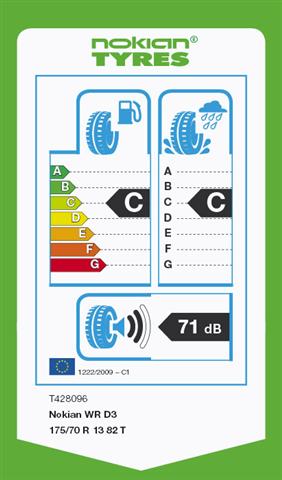
wet braking and external rolling noise. The label has nothing to do with tyre size markings – you can read about tyre sizes here.
The EU tyre label explained
The EU tyre label does not yet cover every type of tyre, although that is likely to change in future. At present the rules apply to all tyres except studded tyres. It is worth noting, however, that the EU label does not measure how winter and all-season tyres perform on snow and ice, as it only rates fuel efficiency, wet braking and noise.
Fuel efficiency – lower rolling resistance 
- Best to worst: A to G – saves up to five full tanks of fuel over the life of the tyres*
- Adjacent classes: B and C – saves 0.1 l/100 km*
A tyre's rolling resistance affects fuel consumption, tyre life and the carbon dioxide emissions caused by tyre wear. Rolling resistance accounts for 20% of a car's fuel consumption. The lower the rolling resistance, the lower the fuel consumption.
The difference in fuel consumption between the classes (A-G) is considerable – around 0.6 l/100 km. Tyres with lower rolling resistance also emit 14g/km less carbon dioxide. Over the life of the tyres, the difference in fuel consumption therefore adds up to five full tanks (240 litres).
Wet grip – greater safety 
Best to worst class: A to F – braking distance more than 18 metres shorter*
- Adjacent classes: B and C – braking distance shorter by one car length*
For summer tyres, wet grip is especially important for safety. Tyres with very good grip have shorter braking distances, are less prone to aquaplaning and make the vehicle easier to control. The rating indicates the tyre's braking distance on wet tarmac from 80 km/h. For example, the difference in braking distance between class A and class F can be 18 metres – roughly four car lengths.
Rolling noise – noise level 
- 3 black sound waves = Exceeds the planned EU limit (75 dB)
- 2 black sound waves = Meets the planned EU limit (72dB)
- 1 black sound wave = More than 3 dB quieter than the planned EU regulations require (69 dB or less)
The rolling noise value indicates the noise pollution the tyres cause. The road noise heard by the driver is not taken into account. In addition to the rolling noise, measured in decibels (dB), the label must show one to three black sound waves in line with the EU directive that comes into force in November 2012.
Based on fuel consumption of 7l/100 km, estimated annual mileage of 15,000 km and a tyre life of 40,000 km. These values are based on tests under EC/1222/2009.
*The EU tyre directive rates both fuel efficiency and wet grip on a scale of A-G. Class D is not used for fuel efficiency, and classes D and G are not used for wet grip.